Tuesday, January 12, 2016

Organic Celeriac Apple Salad
This is an unusual and excellent winter salad.  Except for grating the vegetables, it is very easy to make. 
 
Organic Celeriac Apple Salad
Ingredients:
-        1 medium to large organic celeriac root
-        3 organic apples (firm is better)
-        1/2 cup organic heavy cream
-        1 to 2 teaspoons organic Dijon style mustard.
-        1 teaspoon sea salt
-        2 tablespoons organic lemon juice (less than 1 lemon)
-        ½ - 1 cup organic walnuts (Costco carries organic walnuts now!!)

Preparation:
Peel the celeriac.  Peeling the apples can make the grating easier unless you have a really sharp grater. Grate the vegetables with a hand grater or a food processor.   I used our old Swiss grater.

Combine the cream with the mustard and mix.  Add the salt and lemon.   Mix together again and add to the grated vegetables.  Mix thoroughly and add the walnuts.
 
Peel the Celeriac

 
Grated Celeriac

My old grater... it mushed the apples but it still tasted good.


Apples ready to grate

Finished salad with celeriac, apples, cream, mustard, salt, lemon juice and walnuts.


Monday, January 11, 2016

Simple Organic Vinaigrette Dressing
Ingredients:
  •       1/3 cup Organic vinegar ( I usually use Apple Cider Vinegar that is bottled with the mother) Most stores carry Bragg’s organic.
  •       1 small organic shallot or 1 or 2 tablespoons finely chopped onion (Whole foods has organic shallots)
  •    1 to 2 teaspoons organic Dijon style mustard.
  •    1 teaspoon sea salt
  •    2/3 cup organic vegetable oil like canola, sunflower, olive, etc. (lately I’ve been using olive oil from Costco, but remember it may get solid in the fridge). 


Preparation:
Put the vinegar in a glass container that you will use to store the vinaigrette.  Add the finely chopped shallots.  Sometimes I let this sit for a while so that the onion infuses into the vinegar.  Add salt and mustard.  Add oil.  Shake before using and refrigerate after making.

Additions:
For fancier vinaigrette you can add fine herbs to the dressing (it won’t last as long).  Some use chives, chervil, parsley, tarragon, etc.


Tuesday, November 10, 2015

Saving the Harvest: Raspberry Beets - Homemade Raspberry Vinegar

Fancy Beets sautéed in butter and dressed with raspberry vinegar.
This dish is dinner party worthy.  It is a little more trouble than just roasting beets.  A friend in Boston who is an excellent cook made it for us once.  She is an attorney who also studied at the Sorbonne and lived in Paris.  It was one of those dinners that you keep remembering after you’ve left.  She said that the recipe was from Julia Child but I could never find it. You shred fresh beets (an easy task if you have a food processor).   Then they are sautéed with butter and finally dressed with raspberry vinegar. 
 
sliced raspberry beets with currents
If you are too lazy to get out the food processor and clean it afterwards (like me) or don’t have one, you can slice the beets and proceed with the recipe.  I also once added currants (see pictures).  There is a picture of the shredded beets at the end of this post.  I used beets from our farmer’s market.  Keep them in a cool dark place to use for weeks.
sliced golden raspberry beets with red currents

Ingredients:
-        1 1b of uncooked organic fresh beets - peeled
-        4 tb of organic butter ( I use salted butter) or 3 tb butter plus 1 tb org. olive oil
-        Sea salt to taste
-        ¼ cup homemade organic raspberry vinegar

Shred the beets (easy in a food processor).  Melt the butter (and add the oil) in a flat (fry) pan and then add the beets, salt them and sauté them over medium heat until tender.   Turn off the heat and add the raspberry vinegar to the beets and stir well.  Taste to make sure they are salty enough. 

Organic butter is available in bulk at Costco – it keeps well in the freezer.  If you would like to use less fat, then steam the beets by cooking with a few tablespoons of water (and maybe 1 tablespoon of butter).  Sauté the beets in a little butter for a few minutes then add the water and put a lid over the pan to steam them.  

 
Shredded raspberry beets.  Worth the extra effort!

Raspberry Vinegar:
We always have ever bearing raspberries.  Even if you don’t have much sun, you can plant them in your yard and you can have fresh raspberries from August to early November or the first frost.  For raspberry vinegar I just put some organic vinegar in a pan and heat it to a boil, turn it off, put some raspberries in (as many as you can spare), smash them and add a little organic sugar (we buy this in bulk at Costco).  Organic white vinegar (available at Whole Foods) is also very inexpensive and can be used for fruit vinegars of all kinds. 

Ingredients:
-        1 cup organic vinegar (white or apple cider are good choices)
-        ¼ to ½ cup organic raspberries (frozen organic raspberries are easy to find and work well)
-        1 tablespoon organic sugar or honey

Cooking

Heat the vinegar and sugar to a boil.  Turn off the heat and poor in the raspberries.  If you are using frozen raspberries, then do not turn off the stove, but cook  for a minute or so until thawed. Smash the berries into the vinegar with a potato masher or fork.  You can strain it if you like (sometimes I just use it with the pieces intact).  Refrigerate the vinegar when not using it.  If you are giving the vinegar as a gift, filter the raspberry pieces out and then reserve a few intact raspberries to add after bottling.  AGAIN – KEEP REFRIGERATED.

Wednesday, November 4, 2015

The Monarch Project @ Mercer Road Farm

Notes on Starting a Butterfly Garden – The Monarch Project @ Mercer Road Farm

Just as the bees are in decline, other pollinators – the butterflies (especially Monarchs) are also rapidly disappearing.  This is thought to be from a combination of the eradication of the monarch caterpillar’s primary food source (milkweed) and other farming practices.  Large swaths of the U.S. are planted with plants that are genetically modified (GMO) to withstand herbicides.  These herbicides like Roundup (containing glyphosate) kill milkweed. By the way… glyphosate is also a probable carcinogen (cause of cancer).  Millions (some estimate billions) of monarchs have vanished and their population has been reduced by over 96 percent in recent years.
 

Rose Milkweed


Yellow Coneflower - Ratibita Pinnata


We decided to build a series of butterfly gardens on our blueberry farm.  We do not use any chemicals on the farm, so we thought that it would be a nice safe haven for the monarchs to rest and reproduce.  I had planted a small test garden last year (cheated and used many plants that had already been started – from Prairie Moon).  We have poor clay soil and it is very difficult to grow anything.    I also had planted purple prairie clover, yellow clover, brown eyed susan, Bush's coneflower, culver's root and red monarda (bee balm - I think that the deer ate this). That garden turned out really well – pictured above. 

August - disappointing growth of the milkweed that were planted from seed.  However the monarch caterpillars LOVED the plants!!!!!!!


A third butterfly garden -- slow milkweed growth but the monarch caterpillars loved it anyway.


I had also bought a large number of wildflower and milkweed seeds for other planned gardens.  We got caught by the early snow and could not clear and plow the areas before winter started and so did not get to put the seeds down in late fall.  I put the milkweed seeds in potting soil and stored them in a refrigerator so that I could plant them in the spring.  I did plant most of the milkweed and some of the wildflower seeds.  I was extremely disappointed in the slow start and slow growth of the milkweed plants (see pictures above).  However, I am still hoping that they will come back in the spring.  I will let you know. 

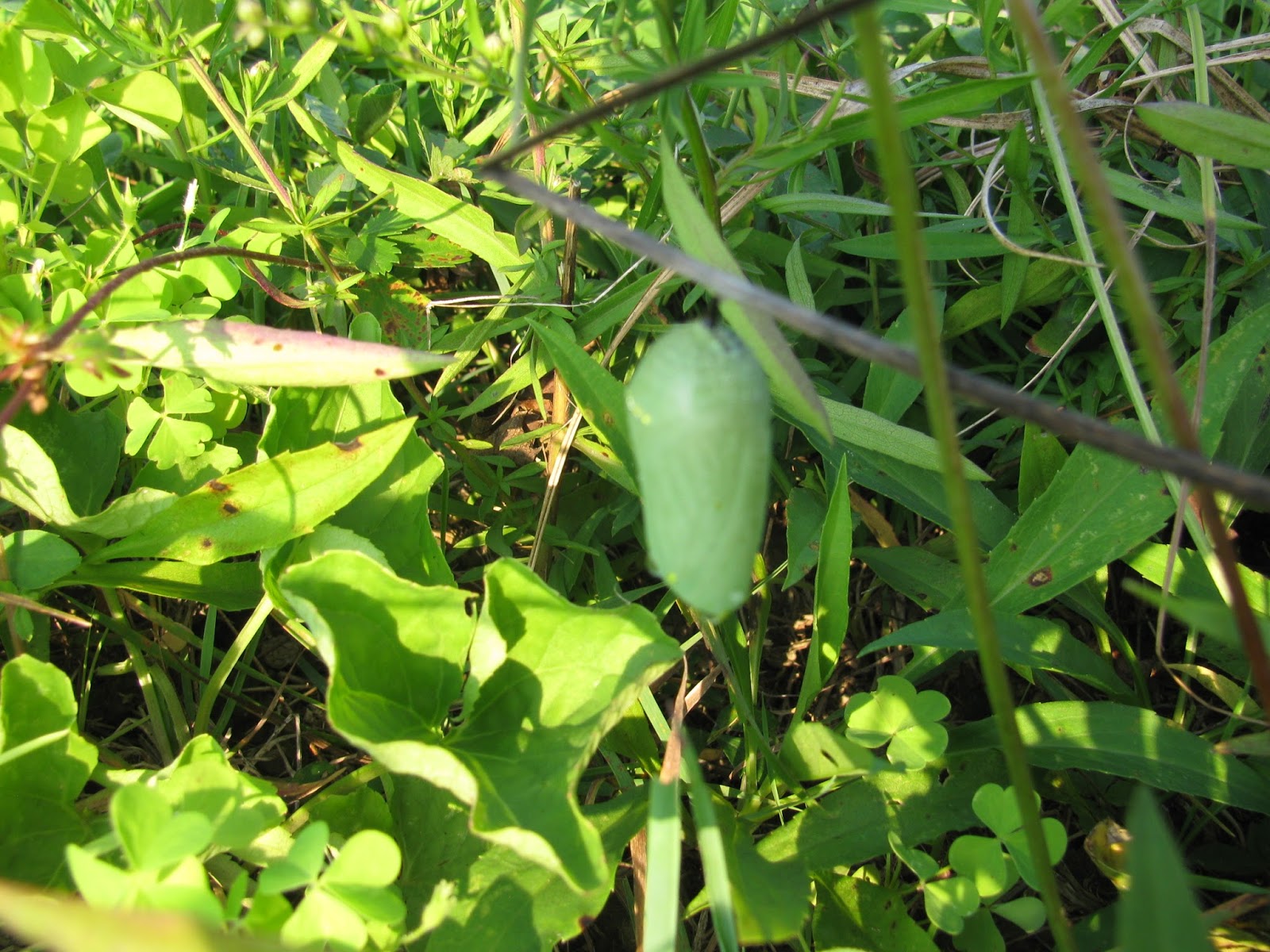
Even though I was disappointed in the plants the butterflies must have loved them.  I went down to hand weed the crabgrass out of one garden and was surprised in late August to find a caterpillar almost every foot or so.  !!!!!!!! Very happy !!!!!!!!  I only found a few chrysalis, but I did have one side of each garden surrounded by large a large unmowed field, so I hope that this is where they built the chrysalis.  I did see many large monarch butterflies in the ensuing weeks.
 

Chrysalis

Here are some notes and observations:
1.  You must choose an area that you will not mow (at least not after early spring).  You might have to weed by hand – at least make sure that no trees are growing. 
2.  Sometimes the caterpillars go “off the reservation” therefore be careful not to mow them or step on them.  I was mowing next to the butterfly garden earlier in the summer.  After seeing the caterpillars around the garden, I have decided this year to surround the gardens with plants that crowd out weeds/grass and do not need mowing.  I will try variegated mint and regular mint as well as Echinacea.  I hope that the caterpillars aren’t bothered by the mint.  I will report back on this. Butterflies seem to LOVE Echinacea and it grows anywhere for me.
3.  If at all possible, plant the milkweed in the fall (instructions can be found at Prairie Moon Farm website and other places).  Otherwise you must follow the instructions for chilling them before planting.  Note that I do not agree with the use of “nontoxic” chemicals to kill weeds and prepare the bed. 
4.  Plant wildflowers and let wild sedge and other nice wild plants grow with the milkweed.  Try to plant with a density that will allow the wildflower and milkweed to crowd out other plants.  
5.  Don’t step in the garden when you see caterpillars.  They may be everywhere and are difficult to see sometimes.  When the butterflies emerge, do not handle them.  They need time to hang upside down to inflate their wings.
6.  The monarch caterpillar can only feed on milkweed but the butterfly will feed on nectar from many kinds of flowers.  Try to keep as many native wildflowers around as you can manage.
7.  Note that most wildflowers do not bloom the first year.  It may take a few years before the garden looks like a wildflower garden.

Here is a list of the seeds that were ordered last year and a picture of the wildflowers and milkweed plants.


Saturday, October 3, 2015

Easy Pickles - Preserve Fresh Cucumbers

Easy Homemade Pickles
These are dill pickles with a hint of sweet.  The end of summer is a good time to buy cucumbers in bulk. Dill is a great herb to have in any garden that has some sun.  It reseeds itself in our garden every year.  The flowers are beautiful and in the late summer can be used for pickles. The small cucumbers are best for use in this recipe, but as long as they are organically grown, the large ones are good to use also.


Ingredients:
  • About 3 lbs organic pickling cucumbers sliced into ¼ inch thick slices
  • 2 cp organic white vinegar
  • 2 cp water
  •  2 tbl salt
  • 1 ½ tbl organic sugar
  • 1 tbl peppercorn, coriander, mustard seed
  • 3 or 4 large dill flowers or a bunch of dill
  • About 2 cloves garlic cut into slices


Optional – cayenne (added to vinegar mixture) or a little sliced hot pepper in each jar to taste


Combine vinegar, water, salt, sugar and dry spices in a nonreactive saucepan.  Bring to a boil.  Meanwhile slice the cucumbers with the skin on into ½ to ¼ inch slices.  Use a very large, very clean glass jar or several small ones.    Place some dill flowers or fresh dill in each jar as well as some garlic.  Place the sliced cucumbers into the jar and poor the hot vinegar solution onto the slices.  After they cool a little cover the jar with a lid and keep refrigerated.

Russian Beet Salad with Boiled Beets, Apple and Potato

Russian Swiss Beet Salad
When you are preparing the beets leave a few out to boil and use them in a fall Russian Beet Salad.  It doesn’t sound good, but make it anyway and you will be surprised.  The salad uses vegetables that are ripe in the fall together and is unusual.  This is also a great recipe to use with Organic Love Beets that are always available – they are cooked and peeled (you can buy them in bulk at Costco). If you don’t want the expensive of buying sour cream, just use a homemade vinaigrette dressing.  This salad is also good using only beets and apples (just use proportionally more).

Use the same amount of beets, potatoes and apples
-        1 part beets (6 medium beets).
-        1 part waxy or salad potatoes (2 large potatoes).
http://www.marthastewart.com/271696/potatoes-101
-        1 part apples (2 large apples).

Dressing:

  • -        1 cup of organic sour cream
  • -        2 tb organic Apple Cider vinegar (we use Braggs Apple Cider Vinegar).
  • -        1 teaspoon organic mustard (we get this at Whole Foods).
  • -        ¼ cup of sour pickles or cornichon (we make them in August when organic cucumbers are plentiful).
  • -        2 or 3 organic spring onions or ½ small yellow onion.
  • -        Sea salt to taste (I used a half teaspoon).

Boil potatoes until tender, boil beets until tender; drain and cool.  Meanwhile, Chop the onions and pickles (fine dice). Combine the onion and vinegar for the dressing.  Let it sit for a minute and then add all of the other ingredients and stir it.   Cut the beets, potatoes and apples into equal sized cubes (we used ½ inch cubes).  Add them to the dressing and stir until combined.  Adjust the salt.


Add the dressing to the cut beet, potato and apple mixture.  Refrigerate if you do not eat it right away.  Serve at room temperature or cold.


Saving the Harvest: Beets

Saving Beets for Winter
We buy beets in bulk in the late summer (for example we can get a 4 qt basket for about 10.00$).  We then slice, blanch and freeze them to roast all winter long.  They can go from the freezer to the oven and be roasted in 1 to 2 hours.  I get them out of the freezer, break them up a little and coat them with organic olive oil and some sea salt.  Then roast them for between 1-2 hours at 350 degrees until at least some are caramelized (a little brown and shriveled).  The longer they roast, the better they taste (but don’t roast them too long and burn them).   I’ve served these beets at dinner parties and have had people ask me how I made them.  Sometimes I think that they don’t believe me when I tell them how simple they are to make.  They are surprisingly good just roasted with good organic olive oil (we get it in bulk at Costco) and sea salt.

Ingredients:
-        Raw organic beets preferable bought in bulk

Prep and Cooking:
Peel the beets.  This is what takes the most time and it is really boring.  Slice them in ¼ to ½ inch slices.  Bring a large pot of salted water to a boil, add the beets and bring back to a boil for about 3 minutes.  Scoop them with a slotted spoon so that you can keep the boiling water and cook them in smaller batches of about 3 cups each.  Let them cool a little and freeze them in flattened portions. 


If you are too lazy to get out the food processor and clean it afterwards (like me) or don’t have one, you can slice the beets and proceed with the recipe.  I also once added currants (see picture).