Monday, September 3, 2018

Escaping the 2018 European heat wave -- Summer trip to the Italian Alps - the Italian side of Mont Blanc


This summer -- 2018 was our hottest ever. Temperatures in Switzerland and most of Europe were in the high 80 and 90 degrees Fahrenheit for weeks on end without a break. There was almost no air conditioning in Switzerland so we decided to head for the hills to try to get a break from the heat. Courmayeur Italy near Mont Blanc was a little over 3 hours to drive so we made a last minute reservation at an inexpensive hotel (about 110 euros total per night, breakfast included) for the three of us and our dog Pearl.

We escaped to the sixty degree temperatures. We were also lucky with our hotel.  The Tavernier was a five minute walk (but uphill) to the shopping/restaurant district in Courmayeur and right next to the glacial stream coming from the mountains -- Fiume Dora Báltea. The staff and owners of the hotel were incredibly nice and kind to us.


This was the view when we came out of the top floor of our hotel and walked over the bridge to town (following 2 photos).  The video is taken from our hotel balcony a few steps out of our room.


Courmayeur was a beautiful little town with older buildings and nice small restaurants. There was a grand hotel in the middle of the town -- the Grand Hotel Royal e Golf. Very old school with an English butler type waiter in a suit serving drinks outside.  It has a grand lobby filled with marble and stag's horns. We had cocktails on their lovely outdoor terrace overlooking the mountains. We tried to go to the restaurant Cadran Solaire afterwards, but will make reservations for dinner ahead next time.  The other restaurant that we went to looked nice and was inexpensive but the food was unremarkable -- it was restaurant Mont Fretty.

We looked at the map and decided to hike up to a mountain lake to swim. Here are pictures of Val Veny and our attempts to hike to Lago Delle Marmotte (marmot lake). We never actually made it because it was starting to rain and it was very long steep hike. We were afraid of getting stuck in a storm so we went back down before reaching the lake.

Photos from the hike to Lago Delle Marmotte (marmot lake)


Thomas and Christian near one of the glacial steams on the hike to Marmot Glacial Lake.


We had to take off our shoes and put our toes into this cold wild glacial stream on the hike to Marmot Lake.


Thomas pausing to rest on boulders -- hike to Marmot Lake.

We only made it to this bridge and turned back.


On the way home we stopped to check out the cross country skiing in Val Ferret for future reference. 

Here are pictures of our hike.


Mountain top - Val Ferret 


 Val Ferret 

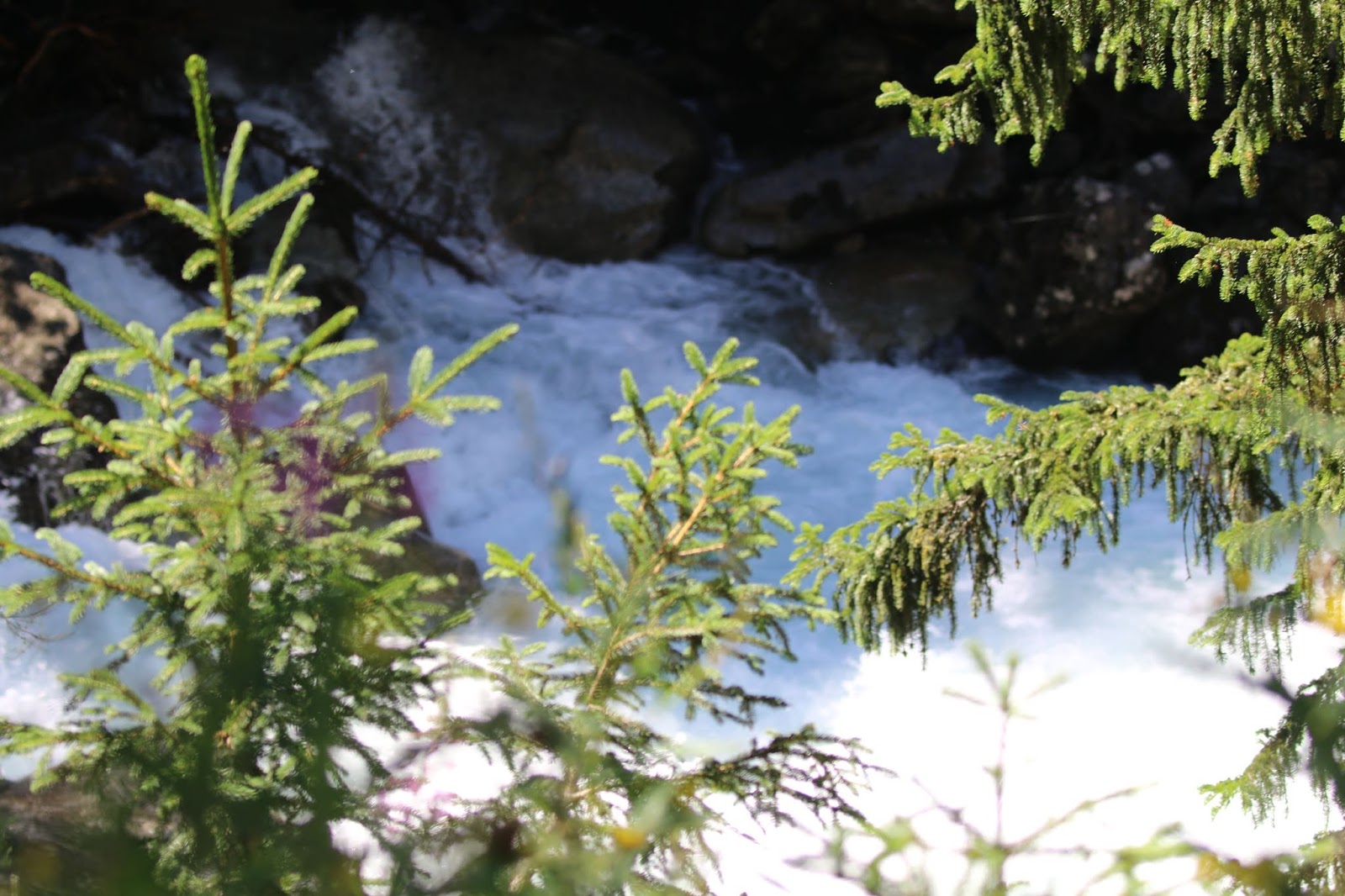
Glacial stream - Val Ferret


Christian also used to para-glide in places like this mountain in Val Ferret


Thistle - Val Ferret 


wild alpine lily

Perennial Cornflower 


Wednesday, July 11, 2018

European Snorkeling Road Trip -- Our first stop on the Lake of Lugano

The view during our drive along the lake of Lugano.
Our stay at Stella D'Italia on the Lake of Lugano
We decided to go snorkeling and our ultimate destination was the island of Elba just off of the coast of Tuscany in Italy.  We took our dog Pearl so we wanted to break up the trip into short drives. We drove about 3 hours from the Zurich area to the Italian part of the Lake of Lugano.  We drove on the road on the cliff above the lake for about 20 minutes to reach Valsolda. We passed through small villages along the lake and finally arrived at the Stella D’Italia hotel.  Our room had a gorgeous view of the lake. The hotel was traditional and beautifully decorated. We ask where our dog was allowed to walk in the hotel and the concierge said “Wherever she wants.”.  

The view from our room.

Our immediate concern was to go swimming in the lake.  We put our suits on and walked through the grounds to the deck.  Only a few people were there laying in the sun. A women was in the outdoor cafe working on a laptop.  We thought that she must have been a famous writer staying here to work on a book. She looked very serious so we did not bother her.  Even the pictures don’t fully capture the beautiful blue color of the clear lake water framed by mountains and by arbors full of roses and bougainvillea.  After a time a family of ducks rested under the deck chairs. When they went back into the water they marched over several feet to the ladder as they had seen the hotel patrons do and jumped into the water from there.  There were also swans further away near where the water transit boat stopped to take people on tours of the lake or to other towns.

View from the hotel grounds and dining area.
Looking up at the dining area rose arbor.
The hundred year old rose bush - Belciana rose.
We had a long dinner that night under the rose arbor.  It was a large structure covered by several very large rose bushes that were said to have been around 100 years old. Each rose plant was as large as a small tree. The view was breathtaking. The appetizer of melon and prosciutto had a surprising addition of burrata cheese. It was a creamy fresh mozzarella-like cheese that was so good we bought several while still in Italy to take back to Switzerland.   We ordered an entire bottle of prosecco to share -- grateful for the gentle prices after drinking 20 dollar glasses of wine in Switzerland with insanely expensive and unremarkable Italian food at our small neighborhood restaurants.

We had also walked our dog Pearl along a brick path that follows a mountain stream and another time up stone stairs that go to a church and then beyond.  We left the next morning to drive through the piedmont to the coast of Italy near Piombino where the ferry goes to Elba.

Wednesday, April 25, 2018

Before and After House Renovations - Cambridge and Pennsylvania Farmhouse

Cambridge Massachusetts Renovation.  

Image may contain: kitchen and indoor
Old Cambridge Kitchen - view looking at back window.
Image may contain: kitchen and indoor
New Cambridge Kitchen - view looking at back window.
Image may contain: indoor
New Cambridge Kitchen - view looking at back door.
Image may contain: indoor
Old Cambridge kitchen view of front window.
Image may contain: indoor
New kitchen view of same front window from dining area.
Image may contain: indoor
Old Cambridge bathroom and shower.
No automatic alt text available.
New bathroom.

Image may contain: plant, house, tree, grass, outdoor and nature
Yard before planting the garden and putting up white fence.

Image may contain: table, plant and outdoor
Garden/yard after fence and plantings.
Image may contain: plant, flower, tree, sky, outdoor and nature
Another view of garden.


Franklin Pennsylvania Farm House Renovation

Image may contain: indoor
Old farm kitchen.

Image may contain: living room, table and indoor
New farm kitchen (same view as old kitchen picture).
Image may contain: sky, house, cloud, tree, plant and outdoor
Back (west side) of the farm house -- original kitchen area.
Image may contain: table, tree, plant and outdoor
The new patio (west) on the back of the new farm kitchen.


View of the patio and back of the new kitchen from the other side.

Sunday, October 1, 2017

Swiss Braided Bread

Organic Swiss Braided Bread

We make this bread at least twice a month.  We've streamlined the process by using a digital scale to measure the ingredients.  Make sure that the scale is set to measure metric (e.g., gram), not imperial measurements (e.g., pounds) and tare the scale (zero it out with the bowl on the scale) after every addition.


Ingredients:
salt 18 grams
organic bread flour 1000 grams = 7 cups unsifted
yeast 15 grams dry yeast(approx. 1 1/2 tbsp)
1 stick of organic butter (plus 1/2 tablespoon - optional)
600 grams or ml organic milk (we use whole milk)

-      Preparation:
Put the bowl on the scale and push tare (use metric measurements).
Add 18 grams salt (tare bowl).
Add 1000 grams bread flour (tare bowl).
Add 15 grams yeast.
Take bowl off of scale and mix dry ingredients.
Soften butter in microwave (about 10 sec.)
Cut butter into flour mixture or add soft butter in flakes so that the pieces are about 1/4 inch thick. 
Flour, butter, yeast and salt mixture with a well of warm milk in the middle.

Pour milk into a glass measuring container and measure 600 ml.  Microwave until warm (99 sec).
Make a well in flour/butter mixture and poor the warm milk into the well.
Roughly mixed dough.  Kneading will mix the dough completely.

Stir until combined a little and then knead the dough in the bowl until it is smooth, homogeneous and elastic - takes about 5 to 8 minutes.
Dough after kneading - now it must sit and rise with a damp cloth or lid over the top.

Cover bowl and let rise until it doubles in size (1 to 2 hours). 
Dough after rising for 2 hours.

This will make 2 loaves of bread.  Roll out one large cylinder and cut it into 4 cylinders of dough that are each about 3 feet long.

Four cylinders for 2 loaves of bread.
Make the first loaf by crossing two cylinders.  First the two ends of the lower cylinder swap places.  Do the same with the other cylinder as in the photographs below.
Cross 2 cylinders to begin braiding.
Cross the two ends of a cylinder over the center.


Brush twice with egg wash and put into a cold oven.  Turn the oven on to 425 degrees and bake 25 to 35 minutes.

When the loaves are braided put them on a cookie sheet lined with parchment paper. Beat an egg and brush the loaves twice with egg wash. Put the loaves into a cold oven.  Turn on the oven to bake at 425 degrees.  In the time it takes the oven to reach the target temperature the bread will  rise a little more.  

Remove the bread after it has turned brown or when a knock to the bottom of the bread returns a hollow sound.

Let cool a little before cutting.


Friday, October 21, 2016

Homemade Thai Green Curry in Bulk

Organic Thai Green Curry to Freeze. 

I make Thai curry in bulk and then freeze it.  I am sure that fresh is better.  However, having it in the freezer allows you to make a quick stir fry or Thai curry dish on work nights throughout the year. This way you can also make the curry with organic ingredients that are easily available in the summer.

I have taken several preparation short cuts as well as quadrupling the recipe.  I would strongly encourage you to buy the book “Real Thai” and to follow her recipes if you like Thai food.   I grow my own lemongrass is it is expensive and it is also difficult to get organically grown lemongrass.  It is a beautiful grass and very easy to grow, especially if you buy it as a small plant.  I usually plant at least two clumps.  The other organic ingredients are relatively easy to obtain.


I pick lemongrass by pulling on each stalk individually and leaving the rest of the plant intact.
Lemongrass, cilantro (the roots can be used) and kaffir lime leaves


Imperial Measurement Notes
1    cup =16 tbsp, so
1/2 cup =  8 tbsp,
1/4 cup =  4 tbsp,
1/8 cup =  2 tbsp

The following quantities are adapted (4 times recipe on page 169) from “Real Thai” by Nancie McDermott.
Green Curry
Ingredients (I use all organically grown)
¼ cup whole coriander seed
4 tsp cumin
20 peppercorns
12 stalks lemongrass
1 cup cilantro
¼ cup ginger
4 tsp lime peel
½ to 3 /4  cup  garlic
½ cup shallot
2 cups green chilies ki noo (I use about ½ to 1 cup of whatever peppers I have that are fresh and add heat to the finished dish instead)
4 tsp salt
4 tsp shrimp paste (this is the only ingredient that I have not found in organic form)

Preparation
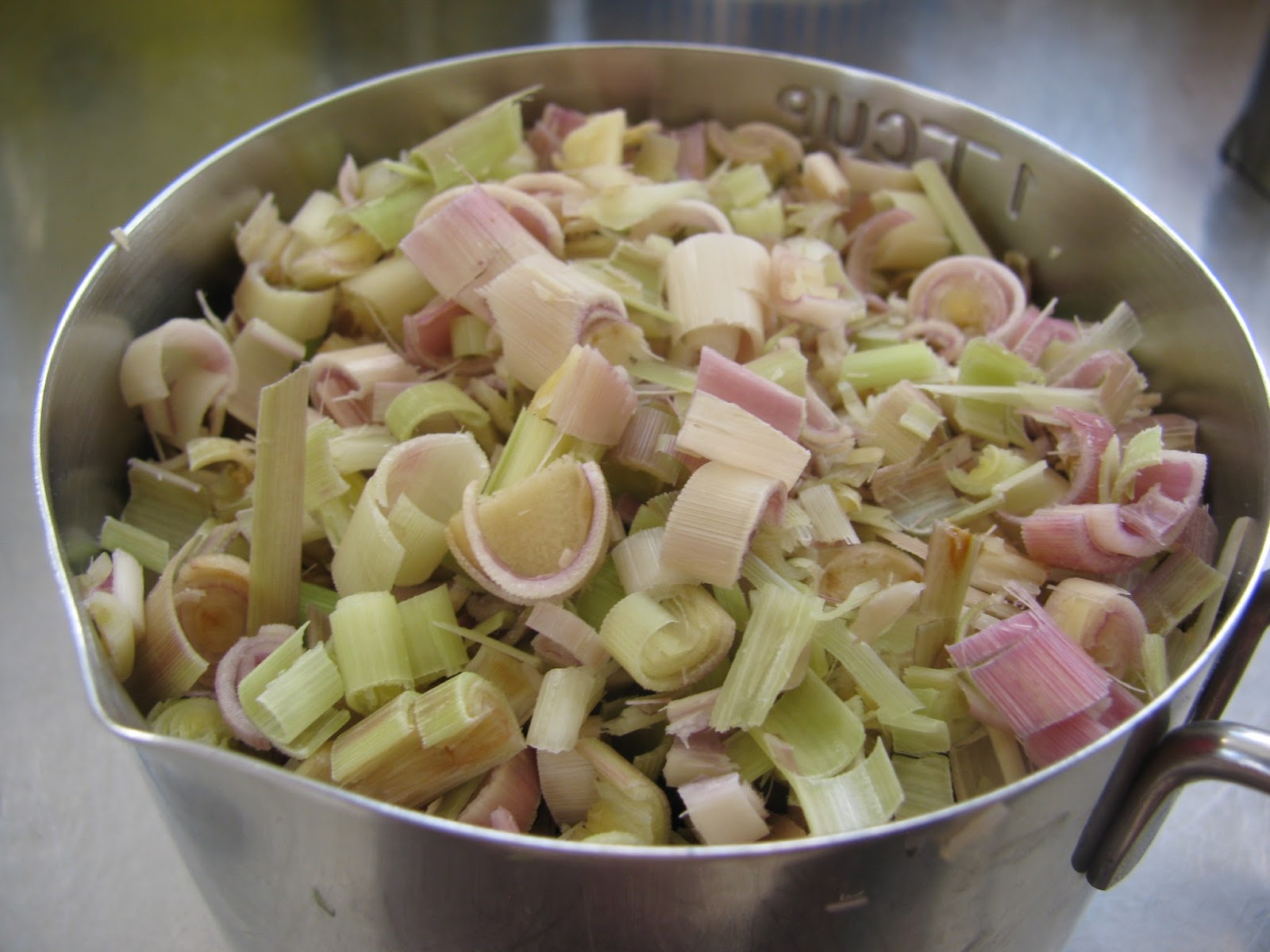
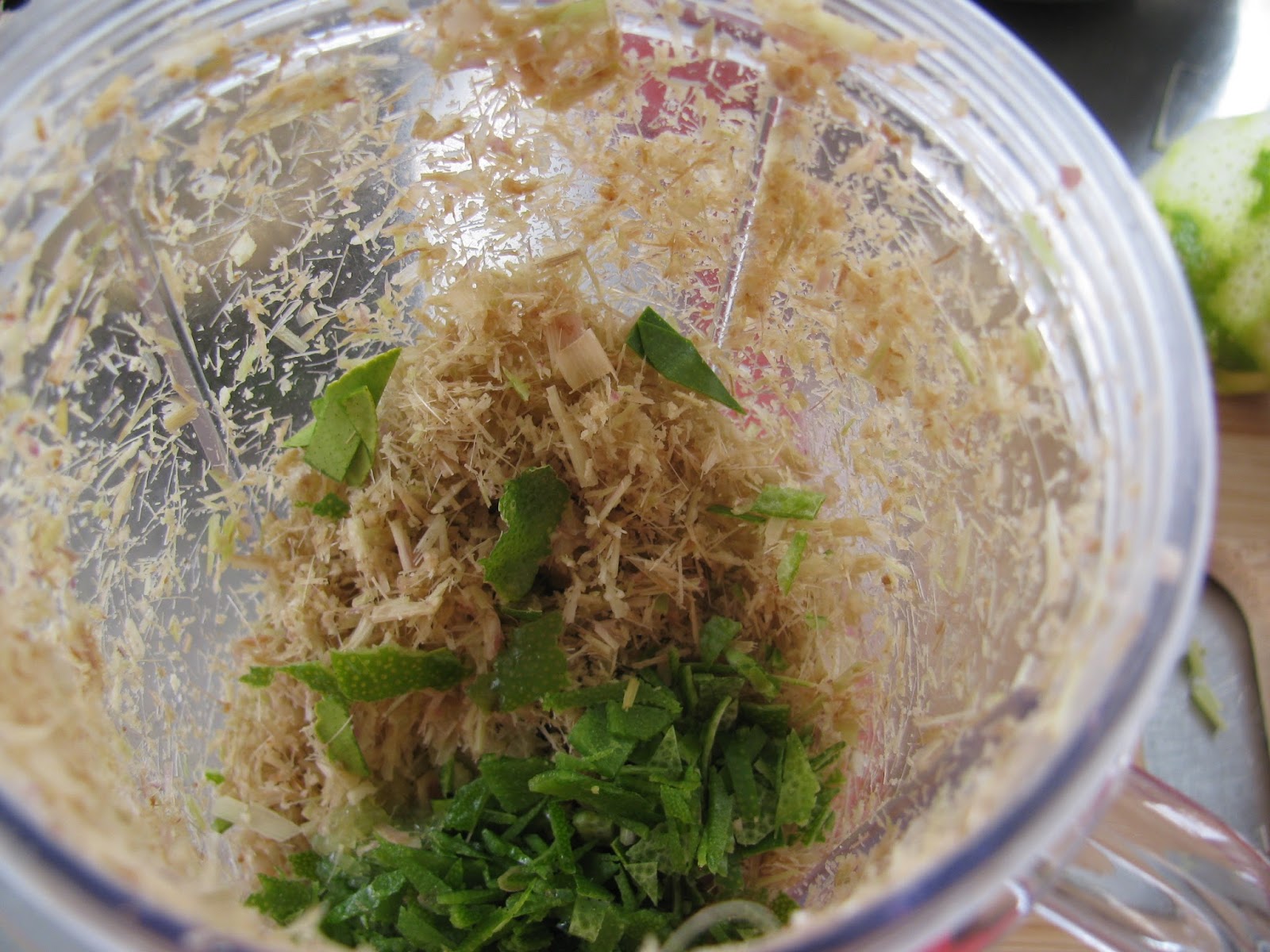
Trim the lemongrass down to the white part and slice in very thin slices.  Peel approx. 2 limes – make sure to get only the green part of the skin.  Rough chop the lime, cilantro and chilies if using a food processor.  Then in order to save time, you may grind the lemongrass, lime peel, cilantro and chilies in a magic bullet or blender until fine and paste-like.  Add this blend to the mortar.  Pound the ingredients together. Chop the ginger, garlic, and shallots as finely as possible. Add all of these ingredients to mortar and pound until broken down and paste-like.  The garlic, ginger and shallots could get bitter when prepared with a food processor, so I try to pound them by hand when I have time. 


Chopped Lemongrass

Lime Peel
Add lemongrass, lime skin, and chilies to a food processor.
Roast the dry spices


Curry Ingredients in a mortar and pestle


Put all of the dry spices into a pan (pepper, coriander, and cumin) and roast for a few minutes on medium heat until you can smell them.  Put them into a spice grinder with the salt (I use the magic bullet with a grinder wheel) and grind until fine.  Add to the mortar.  Add the shrimp paste  Pound the ingredients together again.
Kaffir lime tree - cut up the leaves and use in Thai curry

Kaffir lime and leaf.

Note that I often add a few kaffir lime leaves from my own tree.  Treat them as you would the lime peel.

Freeze in ¼ inch or so layers in bags so that the paste can be broken off and used as needed.

Friday, June 17, 2016

Growing saffron.

Saffron crocus -- growing your own saffron. 
Saffron crocus.  The orange-red stamen are the saffron spice.

Saffron is expensive and difficult to find in some areas.  However, you can plant the saffron crocus bulbs from June to mid-September and harvest the orange stamen for saffron in October.  Let them dry completely before storing. I planted them very deep (maybe 6 inches) and if there are early frosts you would have to use a cloche or a cold frame cover.  On the other hand, you could just harvest the saffron on those years that the weather is not so strange.

Saffron threads.

The crocuses lie dormant most of the summer.  They are not dead.  In fall grass like leaves will come up, followed by the flower.


Slow roasted organic beans with tomato and saffron.

Baby lima beans with tomato and saffron.
 
This dish is very easy, inexpensive (especially if you do not use saffron), and can be reheated for leftovers and reincarnated into several different dishes through the week.  I use oven dried tomatoes that are in the freezer from the summer --  http://savingdragonflies.blogspot.com/2015/09/preserving-summer-roasted-tomatoes-buy.html  

You can eat these beans with a little saffron rice for an almost vegetarian meal (cook diced onion, add saffron and then the rice).   Sausages or chicken may be added or served on the side after the beans are soft.  The beans also make an excellent burrito filling.  Another leftover dish -- add a little anchovy and cook with escarole or kale.  Add anchovy, a little organic tomato paste from a glass jar (no BPA) and some rinsed salted capers and/or oil cured black olives for a pasta sauce.  Note – water can be used instead of stock to make a vegan dish.

Note the blog entry on planting saffron
It is easy!

Ingredients:
-2 cups of organic dried baby lima beans (Whole Foods bulk)
-3 to 5 tb organic olive oil (Costco)
-2 organic onions – diced
-approx. 2 cups of slow roasted organic tomatoes
-2 to 4 cloves organic garlic
-several sprigs (a small bunch) of organic winter savory, summer savory, or herb of your choice (e.g. rosemary or thyme).
-1 teaspoon crushed or ground saffron (optional but use more if you can afford it). 
-1 quart of organic chicken stock or broth (unsalted) plus 1 cup water (Costco).
-salt to taste (at least 1 teaspoon) only after the cooking process.
-optional – add a little of any other spice that you like – I use a little cayenne.  If adding parsley or cilantro do it after cooking while the beans are still hot.

Prep and Cooking:

1 day ahead:  Soak the lima beans in water.  Add water to cover by at least a few inches plus a teaspoon of baking soda – this will make the beans cook faster.

Next day --- Preheat the oven to 300 degrees. Drain and rinse beans.  Dice: 2 onions (0.85 lb or 388 g) and about 3 cups of oven dried tomatoes (mine are frozen) coarsely.  Add the olive oil, beans, crushed garlic, tomato, savory (or thyme, rosemary, lovage, bay, etc.), saffron (crumble or grind first) and chicken stock or broth to a dutch oven or heavy oven pan with a lid (I use a Staub 4 qt).  Add stock to cover all of the ingredients.  DO NOT ADD SALT.
Put into  the 300 degree oven for several hours until reduced and very tender.  I usually cook them for 5 hours with the lid on and then take the lid off for another hour of cooking. After cooking adjust the seasoning and add salt to taste. Add any fresh herbs or additional spices.  Cooking time: about 4 - 6 hours.

Note about dried beans and salt.  In my work I’m always challenging the conventional wisdom.  Therefore I’ve tried cooking dried beans in salted water.  It has worked before.  One day I added salt to cook chickpeas.  Chickpeas from hell.  I checked and cooked them for hours.  Ouch.  After that I have always omitted the salt during cooking.  I think that it depends on the prior moisture content of the bean and possibly several other unmeasurable factors.  To add flavor to beans during cooking now I just add herbs and sometimes onion.

Saffron, garlic and winter savory are relatively easy to grow at home.  See my post on saffron.   When I get garlic that is turning green and sprouting I just separate the garlic bulbs and plant them any time of year (provided that the ground is not frozen).  Garlic is very easy to grow.  If you can find winter savory it is easy to grow and relatively cold hearty.  Savory is THE herb to use with beans.


Roughly chopped frozen oven dried tomatoes.


Summer savory.


Beans, onion, tomato and saffron.
 f


Stock added to the eans, onion, tomato and saffron.